Morgue lab
The Chemistry of DeathThe mortuary lab is the principal setting in which David Hunter tests and interprets physical evidence from the Manham murders. It gives him a place to move from provisional observations at a discovery site to laboratory results that can support, refine, or limit the police investigation. Its significance lies not in producing instant certainty, but in showing how separate traces become a reasoned account of a body’s history.
Forensic work and interpretation
The lab’s work is closely linked to Hunter’s field examinations. At the site where Sally Palmer’s body was found, he explained that blowfly larvae could provide a preliminary time-since-death estimate: the larvae were about seven or eight days old, and the absence of empty pupal cases suggested that none had yet completed the next stage. He combined this insect evidence with the brittle, crumbly adipocere in the soil. Its condition was consistent with rapid decomposition in hot weather, while its limited amount argued against a much longer interval. His estimate remained provisional, but the combined signs pointed to roughly nine or ten days rather than a precise moment of death.
Laboratory analysis later strengthened that estimate. After Marina told Hunter that the results had arrived, he reported to Mackenzie that tests confirmed Sally Palmer had been dead for about nine days when her body was found. The progression from field estimate to confirmation illustrates the lab’s practical role: it gives the investigation firmer ground without erasing the uncertainty inherent in reconstructing events from remains.
Comparative examination and limits
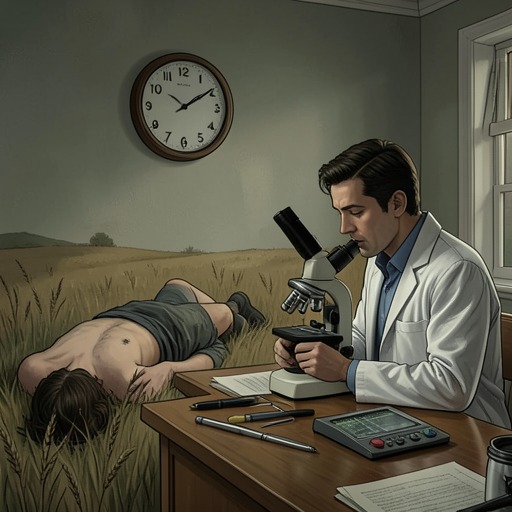
The lab also served as a place to test whether apparently related injuries shared a common source. While examining a dog’s cervical vertebra under a low-powered microscope, Hunter found that its knife cut was rough, with ridges left in the bone. That pattern differed from the smooth cut on Sally Palmer’s vertebra, even though the earlier examination had associated that mark with a serrated blade. The contrast did not by itself identify a weapon or a perpetrator, but it checked an easy assumption: similar-looking violence could not be treated as proof that every cut had been made in the same way.
A second set of remains widened the lab’s work beyond the murders under investigation. The shallow grave held a young man, not Lyn Metcalf; no soft tissue remained, and the bones had taken on the colour of the earth. Hunter expected soil analysis of adipocere to help estimate how long the body had been there. In the meantime, intact teeth, including their fillings, offered a possible route to identification through dental records, while an old, healed fracture in the left tibia supplied another distinguishing feature.
The examination established that the young man was probably in his late teens or early twenties and had suffered repeated blows to the back of the skull from a heavy, blunt object, perhaps a large hammer or mallet. The damage was likely fatal, although the age of the remains made certainty impossible. Hunter found no other sign of violence on the bones. He judged the death unlikely to belong to the current Manham murders: the victim was male, the grave’s occupant had been buried rather than left in the open, and the circumstances differed from Sally Palmer’s case. The lab could clarify what the remains did and did not show, while leaving identification and the connection, if any, to other crimes unresolved.
Later findings and the limits of comparison
Forensic examination of Sally Palmer’s body showed that her throat had been cut while she was still alive: the degree of premature drying pointed to major blood loss, which could not have occurred after death. Soil from the discovery site had a low iron content, inconsistent with the amount of blood expected from a severed jugular. Together, those findings supported the conclusion that she had been killed elsewhere and moved to the place where she was found.
The later results for Lyn Metcalf gave the investigation a second, comparable sequence. Tests established that she had been dead for about six days, implying that her killer had kept her alive for nearly three days before killing her by cutting her throat. Her body, too, showed signs of blood loss, while the low iron content of the surrounding soil indicated that she had died elsewhere and been brought to the marsh. The findings connected the women’s deaths through a repeated pattern without locating the place where either killing occurred.
The physical scene offered little help in identifying the killer. The ground was too baked and hard to retain footprints; apart from rope fibres caught on Lyn Metcalf’s broken fingernails, investigators found no trace evidence pointing to a perpetrator. In the lab, Hunter made final casts of the cervical vertebrae cut by the knife and became more certain that the same weapon had been used on both women. The comparison strengthened the link between the murders, but it did not name the person responsible or explain where the attacks had taken place.
Decomposition as a comparative record
The laboratory’s interpretive work depended on reading remains alongside their setting and condition, rather than treating any one trace as a clock. In examining a dog’s remains, Hunter noted that maggots were giving way to beetles: some larvae were dark and close to hatching, while a few beetles had appeared around the open throat wound. Because beetles tend to arrive later in decomposition and are less reliable indicators than maggots, their presence could refine a comparison but could not settle it alone.
That caution carried into the examination of another woman’s body. Its throat had been cut, and its condition suggested blood loss; the alkali-rich substances released during decomposition had also blackened nearby vegetation. Hunter considered the weather and the body’s state, while keeping his estimate preliminary, and inferred that she had probably been killed elsewhere and left where she was found. The lab’s findings thus linked physical changes to the circumstances of discovery without making those circumstances equivalent to the place of death.
After the analyses of Lyn Metcalf’s remains returned, the laboratory offered Hunter a temporary contrast to the upheaval outside it: a clinical setting in which he could assess results and complete his work. The results established a more specific timeline and strengthened the comparison with Sally Palmer’s case, while the lack of useful traces at the discovery site left the killer unidentified. Once he had made casts of the cut vertebrae, Hunter considered his contribution nearly finished; his attention immediately turned from the evidence to speaking with Jenny Hammond.